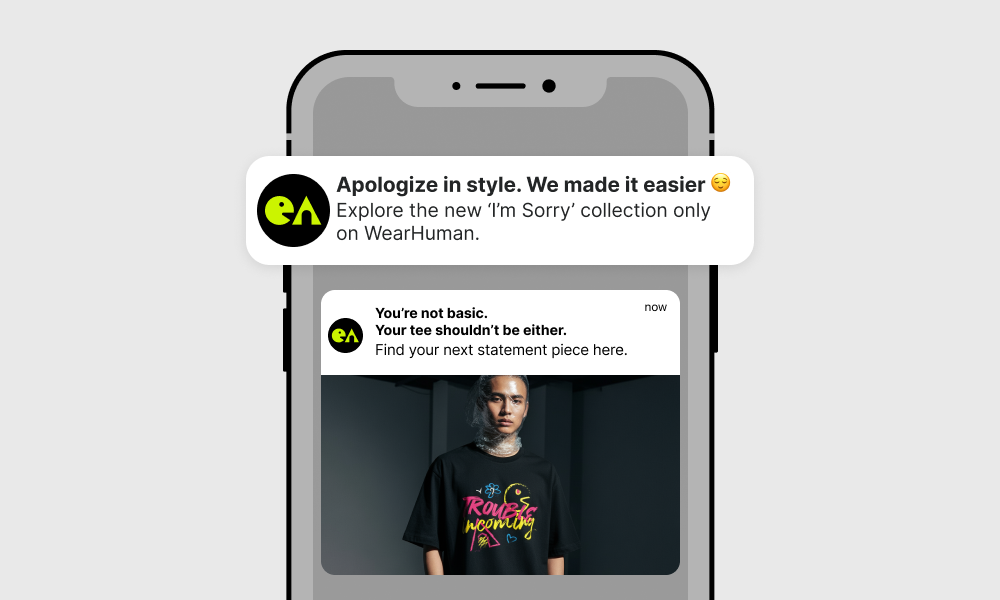
Push notifications (PNs) are the most direct communication channel you have with your users. Yet, for many companies, they often become little more than digital spam—generic, poorly timed, and quickly ignored. The result? High opt-out rates, notification fatigue, and a wasted channel.
The solution isn’t to send more notifications, but to adopt a systematic, data-driven approach. We call this the Effective Push Notification (PN) Framework—a five-step engine designed to transform your push strategy from guesswork into a high-delivery, high-engagement system.
This is how to build Push Notifications that actually work and deliver.
The Core Challenge: Why Most PNs Fail
Before diving into the solution, it’s crucial to understand the problems this framework is designed to solve:
- Complexity of User Journeys: Modern apps have complex, non-linear user flows. A single broadcast message simply cannot address the individual needs of thousands of users at different points in their journey.
- Inconsistency and Over-Communication: Without a structured approach, different teams often send messages ad hoc, leading to users being bombarded, which in turn leads to high uninstallation/opt-out rates.
- Lack of Personalization at Scale: Sending the right message at the right time is difficult to achieve when you don’t first diagnose why a user is disengaging.
The Effective PN Framework addresses these issues by enforcing a structured approach that prioritizes diagnosing user pain before prescribing a message.
The 5-Step Effective Push Notification (PN) Framework
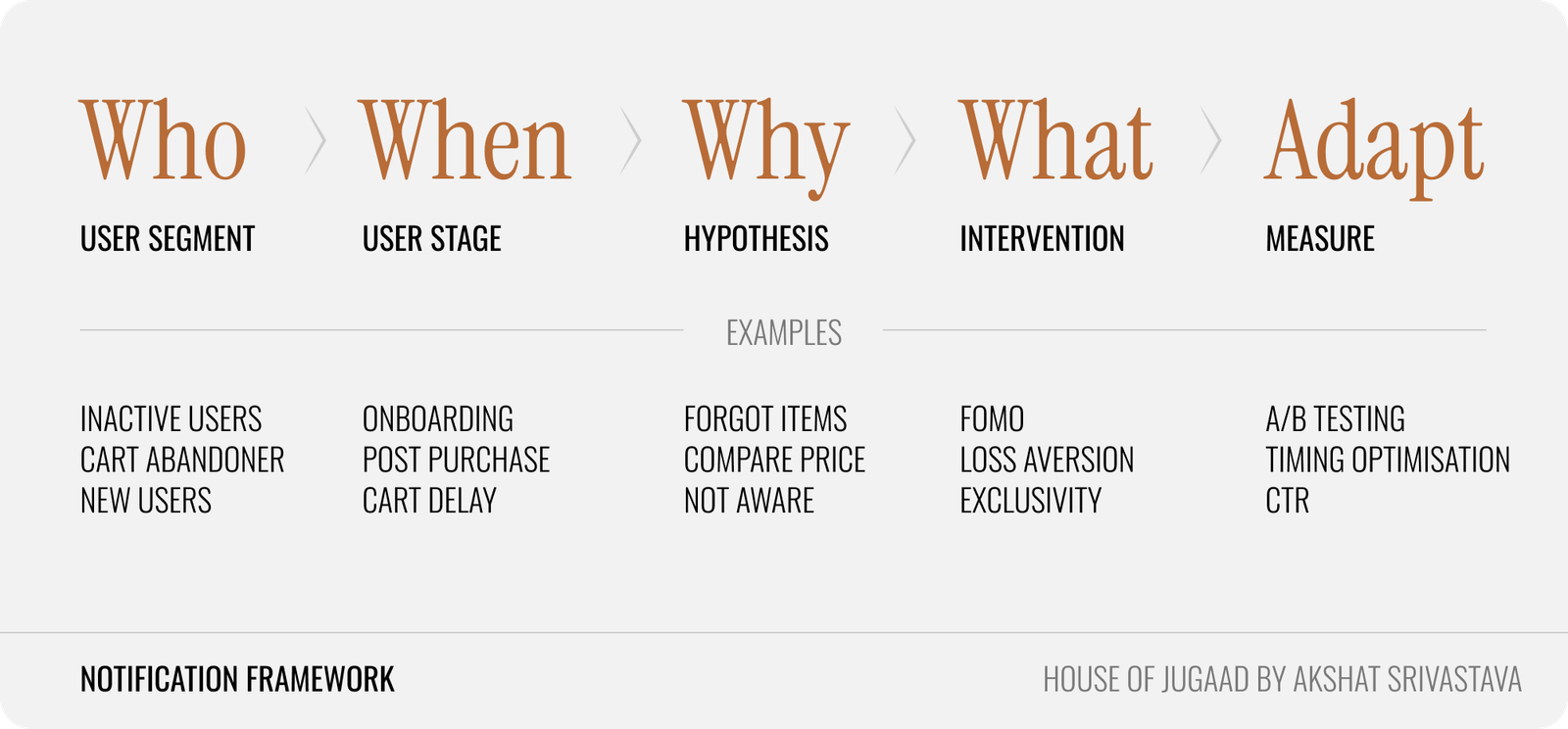
The framework is built on a continuous loop of insight, diagnosis, action, and learning. By strictly following these five steps for every PN campaign, you ensure relevance, optimize timing, and drive measurable outcomes.
Step 1: Define the User Segment (The WHO)
The foundation of any effective PN is knowing who you are talking to. The era of “send to all” is over; your audience must be precise.
- Action: Define segments based on deep behavioral data, preferences, and demographics.
- Focus: A valuable segment is based on a specific action or, more often, a key in-action.
- Example Segment: “Users who viewed a product three times but have not added it to the cart.”
- Example Segment: “Users who are active daily but have never used the social sharing feature.”
Step 2: Identify the User Stage (The WHEN and WHERE)
This step ensures your message is timely and contextually relevant within the user’s journey. Your message should address a user’s need right now, based on their specific situation.
- Action: Determine where the user is in their product lifecycle or a specific task flow. This defines the overall intent (or lack thereof) behind their recent activity.
- Example Stage: A user who has used the app daily for two weeks and is now inactive for 7 days is in the Retention stage.
Step 3: Formulate the Hypothesis (The WHY—The Pain Point)
This is the most critical diagnostic step. The Hypothesis is the diagnosis of the underlying pain point or friction that is causing the user to drop off or remain inactive. It is the challenge your PN must overcome.
- Action: Articulate the assumed reason for the user’s inaction based on the segment and stage data.
- Focus on Pain/Friction:
- Hypothesis Example 1 (Conversion): “The user abandoned the booking because the initial price was too high (price sensitivity).”
- Hypothesis Example 2 (Retention): “The user became inactive because they forgot their small initial commitment to a goal they set.”
- Hypothesis Example 3 (Adoption): “The user is avoiding a complex setup because it feels too difficult or they don’t know where to start.”
Step 4: Design the Intervention (The WHAT—The Counter-Trigger)
The Intervention is your prescribed remedy. It includes the specific content of the push notification and the precise trigger logic designed to directly counteract the pain point defined in the hypothesis. The key to high engagement here is pairing the right psychological trigger with the diagnosed pain.
Psychological Triggers for Effective Interventions:
| Trigger | How It Works | PN Message Example |
| Loss Aversion | Motivates action by framing the choice as avoiding a loss. | “Don’t let your 20% credit expire at midnight! Tap to claim your savings now.” |
| Commitment & Consistency | Nudges the user to complete a task they have already started. | “You’re 75% complete on your profile! Finish now to see all your perfect matches.” |
| Reciprocity | Makes the user feel obligated to respond after receiving value. | “Thanks for your feedback! Here’s a free, exclusive e-book just for you.” |
| Exclusivity | Appeals to the desire to be part of a privileged or special group. | “Exclusive Access: Only our top 100 users can see the new Beta feature today.” |
| Novelty | Triggers curiosity and draws attention with something new. | “A brand new feature just landed! Tap to explore what’s been added.” |
| Zeigarnik Effect | Capitalizes on the mind’s tendency to remember unfinished tasks. | “You left a pending task! [Task Name] is waiting for you to complete.” |
| Inertia Breaker | Gives a simple, low-effort action to restart engagement. | “Hey! Just tap here to see your daily digest—no big commitments needed.” |
| Anchoring | Uses an initial piece of information (the ‘anchor’) to influence perception. | “Original Price was $200. Claim your exclusive $50 offer now!” |
| Empowerment/Control | Gives the user control over their experience, fostering goodwill. | “We’re sending too many PNs? Tap here to adjust your preferences anytime.” |
| Problem-Solution | Clearly states a pain point and immediately offers the solution. | “Tired of slow checkouts? Our 1-click payment is now active! Finish fast.” |
| Social Validation | Uses popularity as a proof point. | “Your friend Sarah just joined. See their activity and join the conversation!” |
By testing and experimenting with different psychological triggers against the same pain point, you can quickly identify the message that drives the highest conversion for that specific user context.
Step 5: Capture Feedback and Iterate (The LEARNING)
No strategy is complete without learning. This step closes the loop, turning your campaign into data that refines future efforts.
- Action: Track key performance indicators (KPIs) to validate or invalidate your Step 3 Hypothesis.
- Primary Metrics: Delivery Rate, Click-Through Rate (CTR), Opt-Out Rate.
- Outcome Metrics: Conversion Rate (was the goal achieved?), Retention Rate (did the user return?).
- Iteration: Use the data to refine the segment, the hypothesis, or the intervention. For example, if the Loss Aversion trigger failed, try the Reciprocity trigger on the same segment to see if that psychological cue is more effective for solving the “price sensitivity” pain point.
The Power of the Framework: High Delivery and Consistent Results
By institutionalizing this 5-step framework, your push strategy moves beyond guesswork, delivering clear and measurable benefits:
- Precision Targeting: By focusing on the WHO and the WHEN, you eliminate irrelevant, generic messaging.
- Increased Relevance: Every message is a targeted solution to a defined WHY (Hypothesis), ensuring high user value.
- Maximum Engagement: By consciously applying psychological triggers in the Intervention phase, you optimize the emotional response, moving users from inertia to action.
- Scalable Personalization: You move from manual creation to systematic, data-driven triggers, allowing you to personalize millions of messages automatically.
Adopt this framework, and you stop being a source of notification noise, becoming a source of timely, relevant, and effective communication that truly delivers.